


Making a sharp left at a tiny country road that runs alongside watery rice fields, I enter Boseong’s Jing Kwang (‘Clear Light’) valley in South Korea’s South Jeolla Province. Since the Goryeo dynasty (918–1392), the area has been known for its wild green tea, grown by Buddhist monks at Jing Kwang Temple deep in the mountains. I’m headed for the Jing Kwang Tea Fields and Culture Estate in the foothills of Geumhwa Mountain, which is where Sang Hoon Han came in the early 1970s to rediscover how to grow Korean wild green tea and make onggi pottery.
At the time, Han was working for Encyclopaedia Britannica’s branch in South Korea, managing its traditional-culture research department. He met Korean potters, metalsmiths, weavers and tea growers who’d inherited their skills from previous generations and became fascinated by his country’s homegrown arts, crafts and farming. Hence his ambitious creation of a cultural village in Jing Kwang Valley, which would act as a hub for the research and revival of time-honoured practices that were neglected during the Japanese occupation of 1910 to 1945.


The first tea bushes arrived on the Korean peninsula during the reign of Queen Seondeok of Silla in the seventh century and green tea has been cultivated in Korea ever since. But in the early 20th century, Korean tea bushes were mostly replaced with imported Japanese alternatives. Han sourced those lost varieties and learned the methods of wild tea-farming that were first practised in Buddhist temples in the mountains. Twenty years after Han’s death, the Jing Kwang Tea Fields and Culture Estate is still run by his family. Upholding painstaking traditional methods, Mu Non – Han’s son and heir – works with his wife and mother to grow wild organic green teas, and make traditional onggi earthenware on this unassuming estate surrounded by lush foliage and wild plum trees.


First, Mu Non drives me up to the tea fields. It is late afternoon and the sun is beginning to wane, but although we are travelling uphill it still remains light. The car slows from the incline, and the dirt road gets narrower and rockier as thick undergrowth spreads out. After about 20 minutes of driving through the forest, Mu Non points to an opening that leads to a slope covered in wild arrowroot vines. He walks into the thicket and starts pulling aside branches. Underneath lie rows of wild tea bushes with healthy, shiny leaves.
‘Whatever you plant, if you give it fertilizer, it attracts pests and insects. Then, you have no choice but to use pesticide,’ he explains. ‘Here, we grow our tea bushes in the wild and all I do is thin out the low-lying thicket three times a year. Tea bushes grown with fertilizer can be harvested five or six years after planting, but those left to grow and survive in the wild need to wait about ten years.’

This long interval allows the bushes to become more resilient and strong, and deepens their flavour and clarity. The tiny, first-flush leaves are picked by hand when they start appearing at ip-ha (the first day of summer), then fired in giant round iron pans at temperatures of up to 400°C. Na Young In, Mu Non’s wife, has learnt the art of pan-firing from her mother-in-law, Jeong Geum Cha. Only a skilled tea-maker can perform this task without burning the leaves or their hands. The two women, and others from the local village, work as teams to roast each batch of leaves; after the first pan-firing, they roll, rub and knead them vigorously on straw mats to liberate the fragrance. The process is repeated nine times.
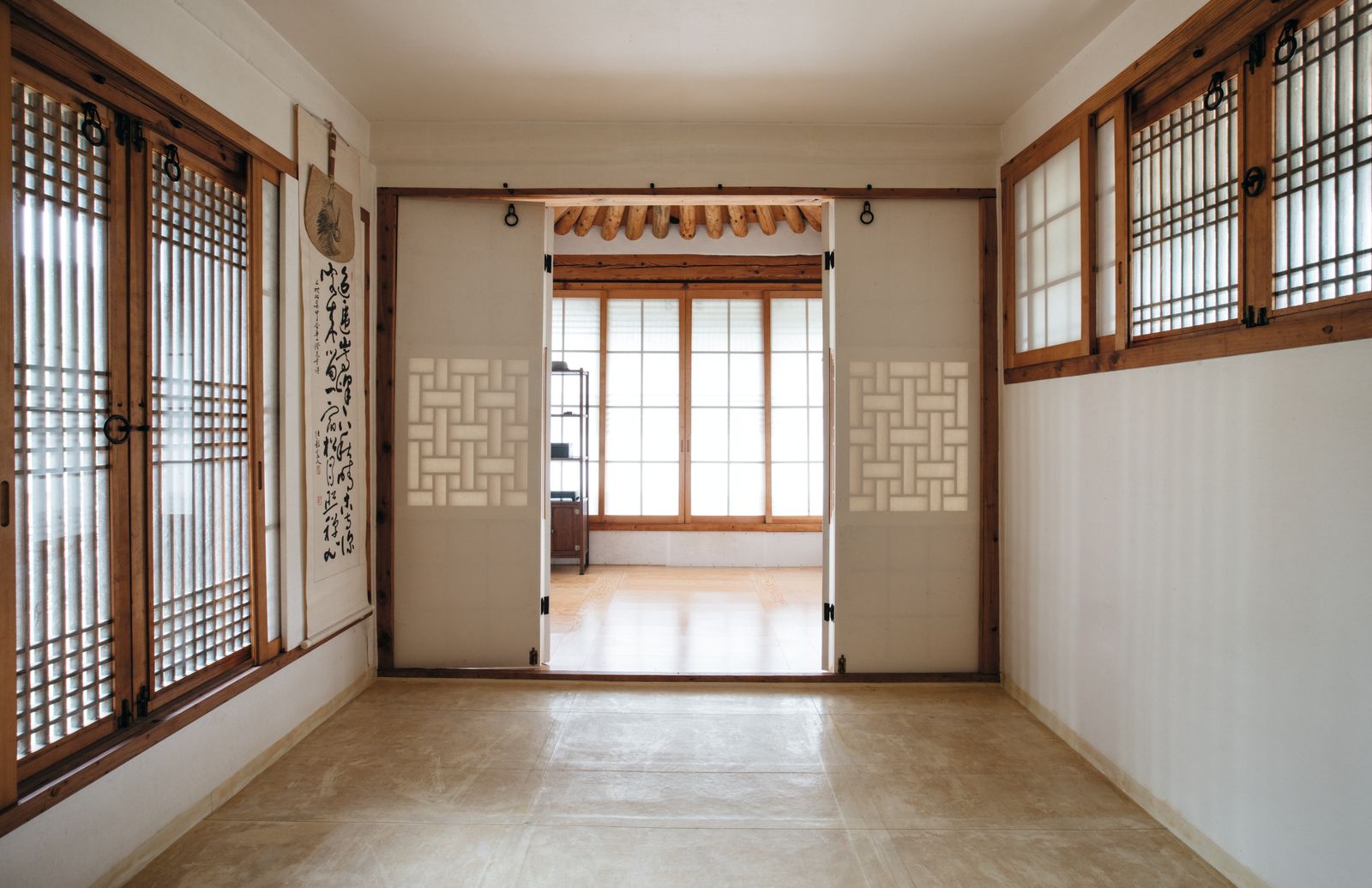
The next morning, coming down midway from the tea fields, I arrive at Han Sang Hoon Ga Ok – the Han family’s hanok or traditional stone, clay, wood and paper house. Originally built in Seoul, these structures were salvaged by Han in 1981 and brought here beam by beam to save them from demolition. There are two buildings, both built entirely of wood and yellow or white clay, with no metal joinery. Roofs are tiled with ceramics and stones are used as the base for wooden columns. The interiors are covered with hanji, a paper made from the inner bark of paper mulberry trees, which is fibrous and versatile. It is used extensively in hanok architecture for floors, windows and walls. When starched, fine hanji paper becomes taut and leather-like, keeping out the cold air in winter and sealing out humidity in the summer.
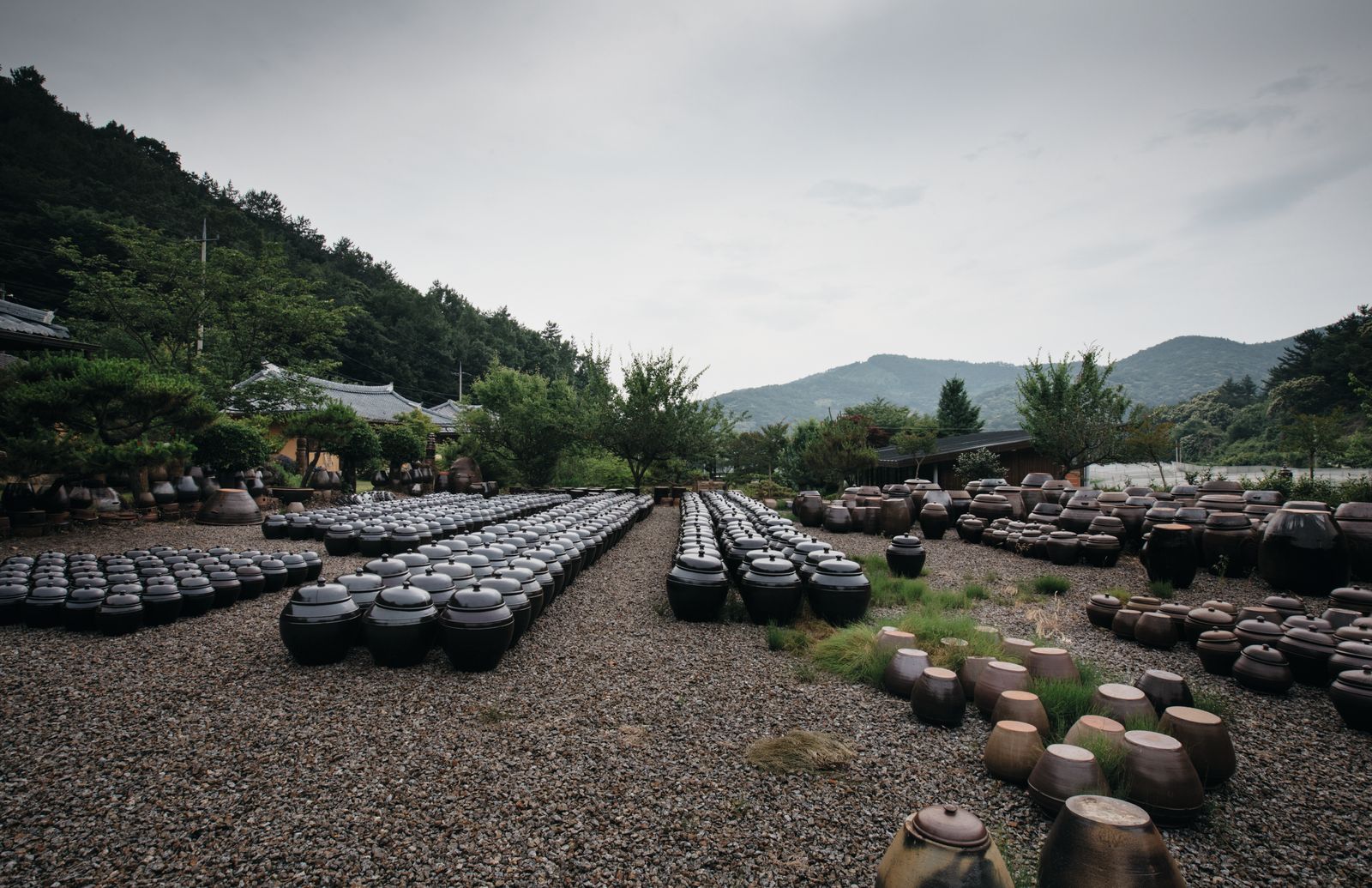
Coming back down to the main estate from Han Sang Hoon Ga Ok, I find the long rectangular studio in which the onggi pots are made. The simple structure of rough, packed red clay is held up by curved wooden beams with tree trunks as columns. In the wide courtyard outside, onggi vessels sit in the sun; the clay from which they are made is found two levels below the topsoil. Their glaze is a slip made from combining finely sieved clay from a freshwater lake bed, or pure mud from the edge of a valley, with rich humus washed down from the mountain, blended with kitchen-fire ash. This is applied to the pots’ interiors and exteriors; once fired, it creates minuscule pores that allow the pottery to breathe.
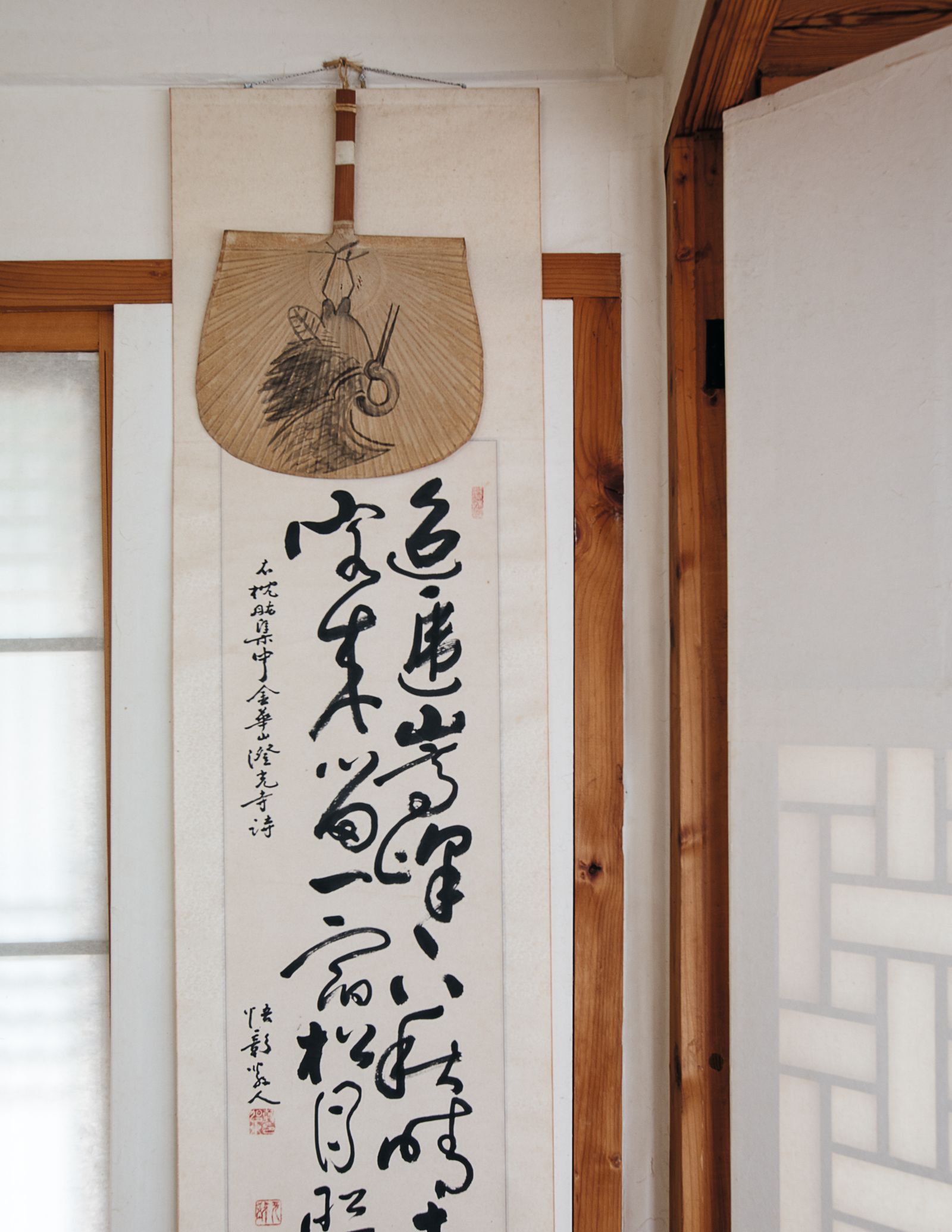
Inside the sarangbang, originally the quarters for the master of the house, sunlight filters through delicately onto the ondol (heated stone flooring). Its surface is finished with jangpanji, heavy hanji paper that is hand-brushed with soybean-extract coating to make it water-resistant. Heating the floor over time gently bakes the jangpanji into an invitingly warm, amber hue. Objects such as bedding, cushions or personal items are stored invisibly in built-in cabinets behind hanji walls in each room, for a hanok is designed to provide space around those who use it. The paper interior has removable doors and windows, making it light, airy and spacious.
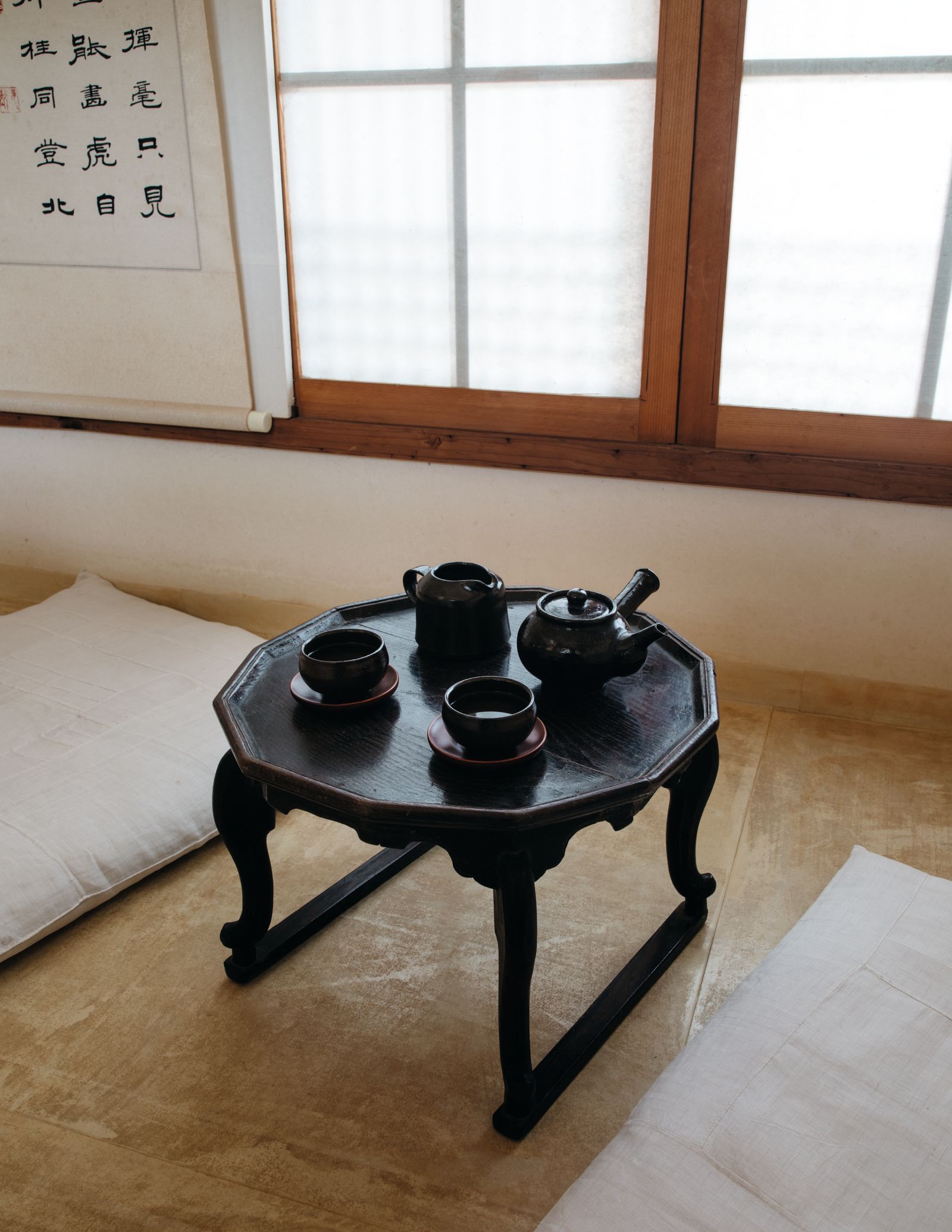
The shadow of a pair of swallows sitting on a persimmon tree outside frames the translucent paper window. A small daban (tea table) is brought in by Na Young In with green tea roasted from this April’s harvest. Jeong Geum Cha beams widely, as we take a sip of the delicate green beverage. ‘Our ancestors used to say: if you want to clear your mind, go drink tea.’
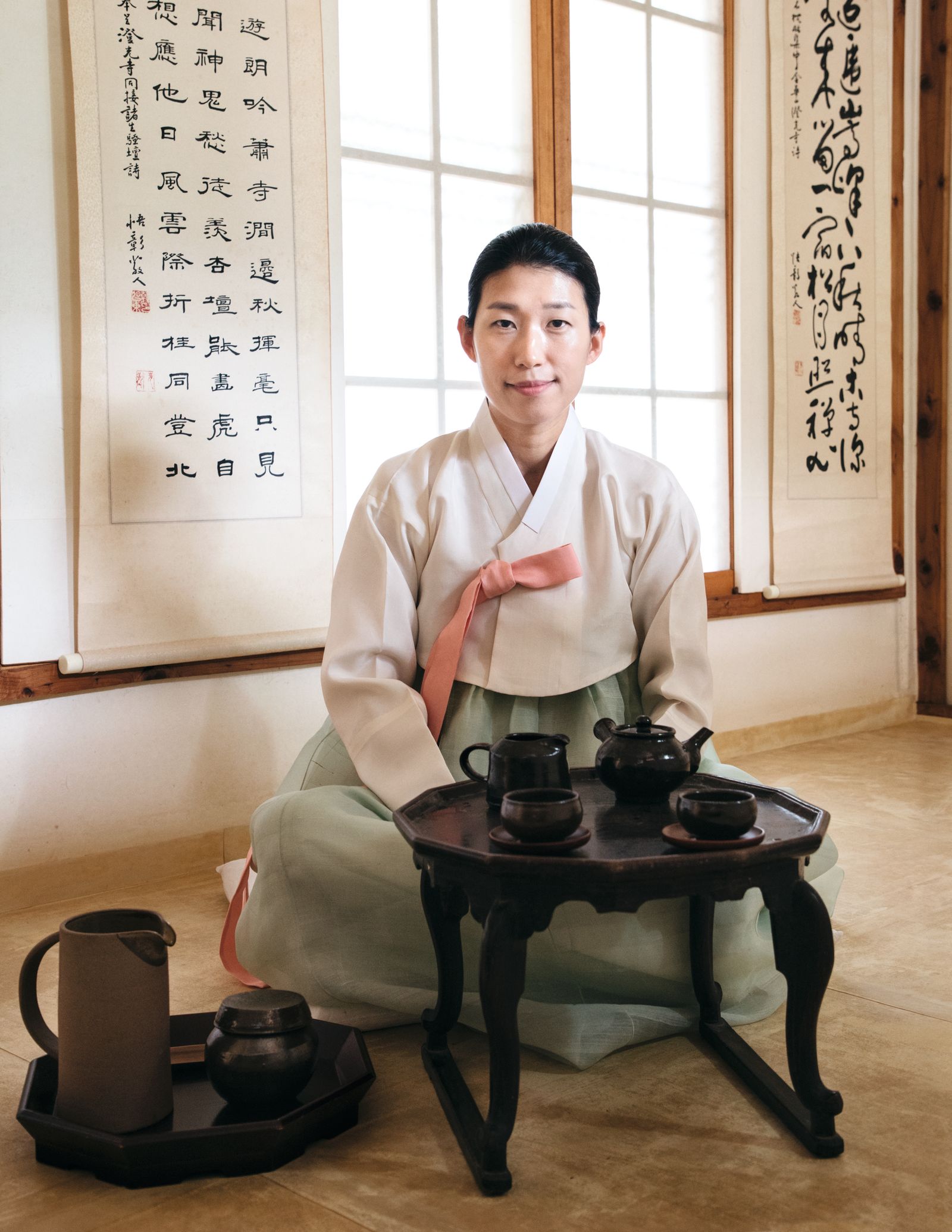
The Jing Kwang Tea Fields and Culture Estate. Ring 00 82 10 5318 0108
A version of this appeared in the October 2019 issue of ‘The World of Interiors’. Learn about our subscription offers


