


It is 9pm in Shanghai when Zhou Xue Ming appears on screen, though there is nothing unusual about the hour. The 34-year-old hairstylist and wig artist often works late. Mornings belong to his one-year-old son; evenings to the studio, where wigs hang from walls, balance on stands and gather in corners like exotic birds not yet ready to fly. Zhou is softly spoken. Around him, however, the room is anything but reserved: ‘like a hair jungle’, he says.
By day, light pours through the crooked Venetian blinds of his Pudong studio and falls across the black, rubbery floor he hastily laid down when he moved in in 2018. He is not far from the Huangpu River, but the water is hidden from view. What Zhou sees, and likes, is the evening light. ‘During sunset it’s very beautiful,’ he says. ‘I look out when I need inspiration.’ Zhou once made wigs at home, where the work was smaller by necessity. As they became more ambitious, space proved to be a practical problem for which finding a studio was the only solution. His recent pieces are up to two metres tall, needing to be hung, propped up or eased on to the wearer by several people. ‘My wigs have a lot of shapes. Naturally, they are all art,’ he says. Against the walls lean canvases on which lengths of hair loop and climb like botanical diagrams – old wigs fixed to canvas for a life beyond the shoot, no longer something to wear.
‘For me, each wig is a blank,’ he says. ‘I can dye it, cut it, make it into different shapes.’ In Mandarin he calls it a máo pēi, a rough shell: ‘like a house with nothing inside’. His forms often begin through trial and error: a wig is dyed and cut, pushed into shape, then set aside if it does not
work. He also keeps a one-off book of his own wigs in the studio – ‘only one copy’, he says, ‘not for sale’ – a private record of past styles. His reference images are his own experiments: shapes to look back at, rework or fold into something else.
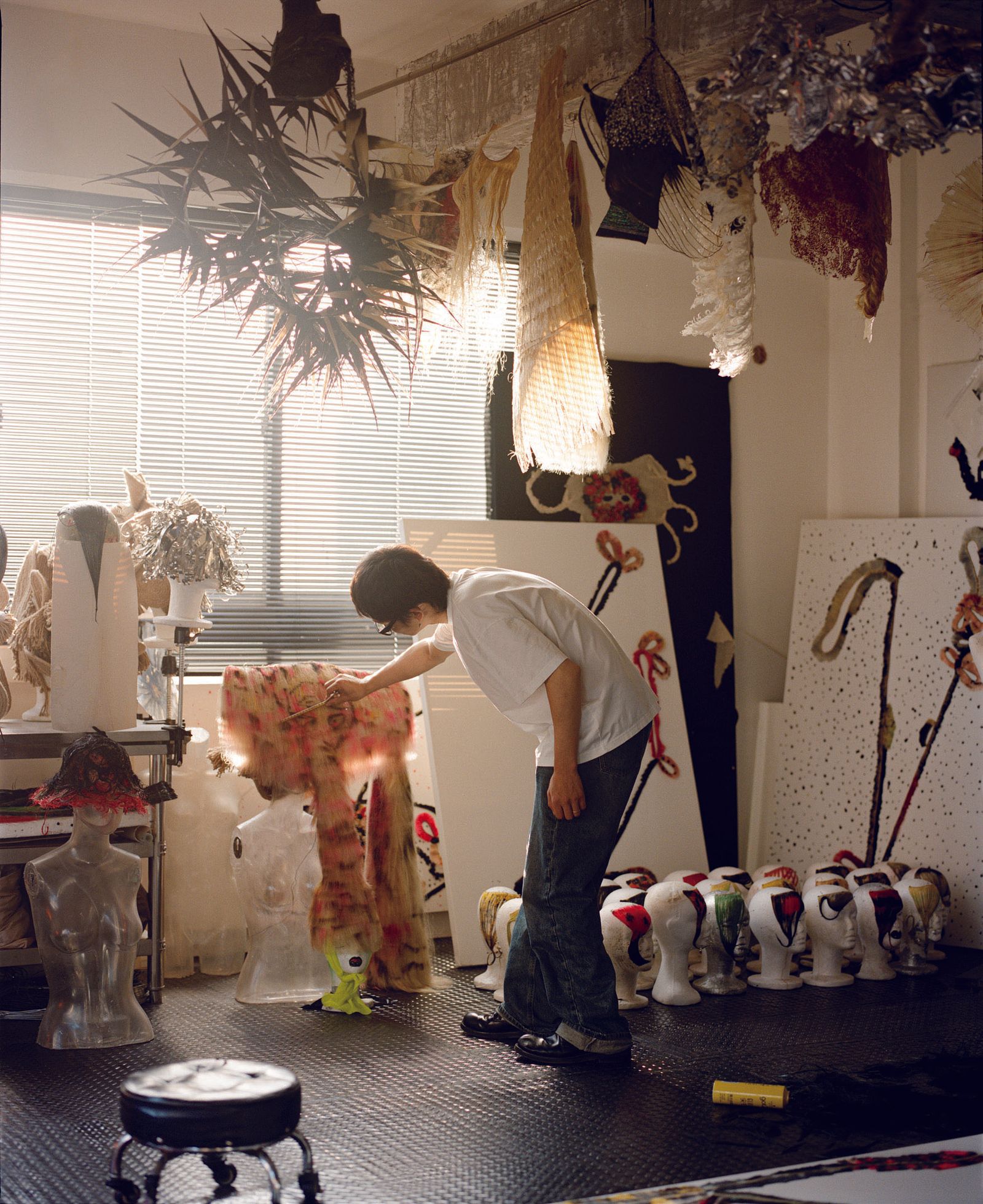
The room can be chaotic – that he can admit. ‘As soon as I have a new idea, I act on it immediately,’ he says. ‘I don’t let ideas remain confined to my mind. And when I’m creating, I don’t think about keeping it tidy.’ Metal shelves hold wigs in various states of completion. From the ceiling hang larger works in straw, hair, nets, braids and foil. On a blue trolley sit heads, combs, sprays, scraps of hair and chemicals. No fewer than 12 blow dryers lie tangled in a plastic bucket, ‘almost all broken from use’.
Buckets then become moulds; glue guns fix sequins and jewels into hair. ‘I’ve heard there is a smell,’ he says, ‘but I’ve been used to it for many years.’ Zhou grew up in Shouxian County in Anhui Province, where his family ran a restaurant. At school, he was ‘mischievous’. What he recalls mostly is hair, styling his own in junior high, wearing it upright in homage to punk, listening to rock music and watching films that offered another visual grammar. The 1996 film Trainspotting, with its ragged crops, buzz cuts and sense of youth in revolt, was formative. ‘It blew my mind when I first saw it,’ he says. After leaving school, he became an apprentice at a local barber’s.
Some years on, Zhou’s work travels internationally through campaigns, runway shows and magazines, including Vogue, Dazed and W. For Mugler’s spring/summer 2025 show in Paris, he fashioned the vision-obscuring hairpieces sported by models on the catwalk and by Cardi B on the front row – a prized seat, even if his handiwork meant she could barely see. For Zhou, wigs are practical tools too.
Instagram content
On editorials and commercial campaigns, they allow him to transform a model quickly and radically, without the limitations of working on what someone has been naturally blessed with. ‘If you use a model’s own hair, it’s very difficult to do many things in a short time,’ he says, whereas a wig can be dyed, cut, sculpted and replaced at some speed. Just as his wigs provide a dramatic mask for their wearer, Zhou too has a taste for privacy and disguise. Beyond the studio door, the high-rise hums on with more quotidian work: fitness businesses, mathematics tutors and corporate offices, giving no hint that his more unconventional atelier is hidden behind this mundane façade. ‘People here don’t know what I do,’ he says, but inside the studio is charged.
‘Everything inside it carries emotion, and every wig has a purpose,’ he adds. ‘Whether I’m making it, whether finished, or just sitting here, each wig has a space for imagination.’ Even beauty is not passive. ‘If it’s beautiful, then it has a use,’ he says.
Visit Instagram @zhou_xue_ming
A version of this article appears in the August 2026 issue of ‘The World of Interiors’. Learn about our subscription offers
Sign up for our bi-weekly newsletter, and be the first to receive exclusive stories like this one, direct to your inbox


